

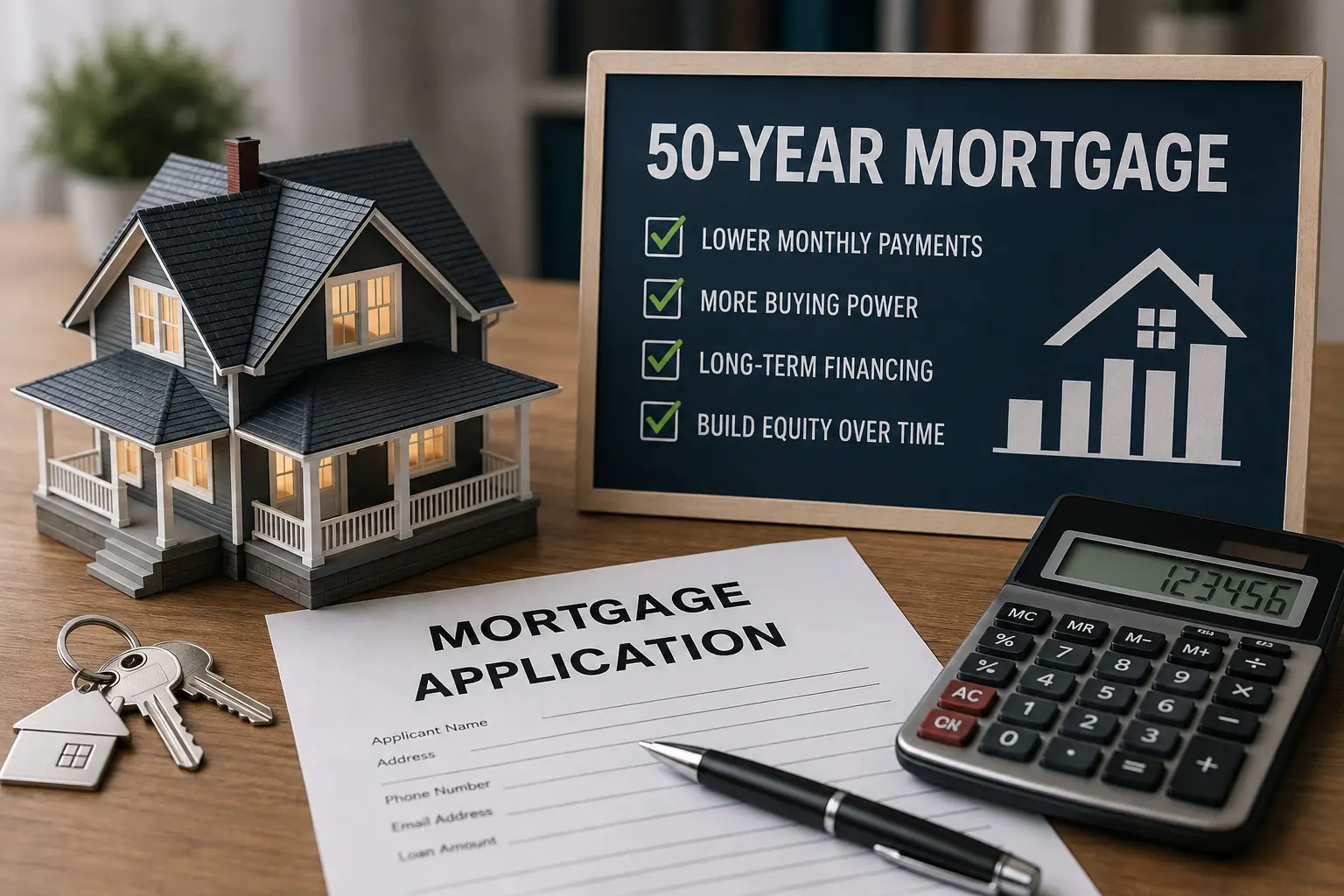
A 50-year mortgage spreads home-loan payments across five decades, which would make the monthly payment look easier than a 30-year loan. In the U.S., though, a standard 50-year purchase mortgage is not widely available, so you need to understand the rules, long-term interest cost, slower equity growth, and practical alternatives before treating it as a normal loan option.
Important note
This article provides general information, not financial or legal advice. Mortgage rules, lender policies, rates, and product availability change, so verify current terms with a qualified mortgage professional and the applicable official disclosure before making a borrowing decision.
1. What Is a 50-Year Mortgage?
A 50-year mortgage is a home loan amortized over 50 years rather than the more common 15-, 20-, or 30-year terms. A longer amortization period spreads principal repayment across more monthly payments. This lowers the principal-and-interest payment when the interest rate and loan amount stay the same, but it also keeps the debt outstanding for much longer.
2. Are 50-Year Mortgages Available in the U.S.?
As of 2026, a standard 50-year mortgage is not a mainstream U.S. purchase product. The Consumer Financial Protection Bureau states mortgage terms for most homes are typically 15, 20, or 30 years. Recent coverage from Experian also describes the 50-year mortgage as a proposal rather than a broadly available consumer product. Limited longer-term loans or loan modifications exist in parts of the market, but these are different from a standard federally backed 50-year purchase mortgage.
3. Why Did 50-Year Mortgages Get Attention?
The idea gained attention during the U.S. housing affordability debate. A longer loan term reduces the required monthly principal-and-interest payment, which might help some buyers qualify for a home with a high purchase price. The trade-off is a much longer repayment period and a potentially much larger lifetime interest bill.
4. How Would a 50-Year Mortgage Work?
A fully amortizing 50-year fixed mortgage would use the same basic payment structure as other fixed-rate mortgages. Each payment would include interest and principal. Early payments would contain a larger interest share, while the principal balance would fall slowly. The CFPB explains which mortgage payments depend on the loan amount, term, and interest rate, with taxes and insurance often added to the total monthly housing payment.
5. How Much Lower Could the Payment Be?
Consider an illustrative $350,000 loan at a 6.87% fixed rate. The rate is held constant only to isolate the effect of the loan term. A 30-year schedule produces an estimated principal-and-interest payment of about $2,298 per month. A 50-year schedule at the same rate produces about $2,071 per month. This example is not a 2026 50-year mortgage quote, because actual 50-year products and pricing are not broadly established.
6. Why the Lower Payment Comes at a High Cost
The lower monthly payment does not mean a lower borrowing cost. In the same illustrative example, the 30-year schedule would produce about $477,309 in total interest if the loan stayed in place for the full term. The 50-year schedule would produce about $892,690 in total interest at the same rate. The difference is roughly $415,381. A real 50-year product would have a different rate, fees, insurance structure, or repayment terms, so use these figures as a term comparison rather than a market estimate.
7. What Happens to Home Equity?
Longer amortization slows the pace at which your loan balance falls. If home prices stay flat, you build equity more slowly through principal repayment. If prices fall, a larger outstanding balance would leave you with less protection between the home's value and the mortgage debt. Your equity also depends on your down payment, home value, loan balance, and any additional principal payments.
8. What Are the Main Pros and Cons?
The main potential advantage is a lower required monthly principal-and-interest payment. This would improve monthly cash flow for a borrower who has a stable income and understands the long-term cost.
Pros
- Lower scheduled principal-and-interest payment than a shorter loan at the same rate and balance.
- More monthly cash flow for other household priorities.
- A longer repayment schedule would help some borrowers fit a payment into a strict budget.
Cons
- Much more interest over the full repayment period.
- Slower equity growth.
- A mortgage which would extend into retirement for some borrowers.
- Limited availability in the U.S. mainstream market.
- A longer term does not solve high home prices or other ownership costs.
- A higher rate on a longer-term product would increase the cost further.
9. How Does a 50-Year Mortgage Compare With Other Options?
A 30-year fixed mortgage remains the standard long-term benchmark for many U.S. buyers. A 15-year mortgage generally requires a higher monthly payment but pays the balance down faster. A 40-year loan exists in limited non-qualified mortgage markets and also appears in some hardship modification programs, but it is not the same as a widely available standard purchase loan. Buyers should compare the full loan estimate, not the monthly payment alone.
Comparison
Loan term | Typical role | Main trade-off |
15 years | Faster payoff | Higher monthly payment |
30 years | Common long-term mortgage | Balanced payment and payoff period |
40 years | Limited market or modification use | Lower payment, higher lifetime interest |
50 years | Proposed or highly limited structure | Lowest scheduled payment among these terms, with the longest repayment period |
15 years | Faster payoff | Higher monthly payment
30 years | Common long-term mortgage | Balanced payment and payoff period
40 years | Limited market or modification use | Lower payment, higher lifetime interest
50 years | Proposed or highly limited structure | Lowest scheduled payment among these terms, with the longest repayment period
10. Who Might Consider a 50-Year Mortgage?
If a 50-year mortgage becomes broadly available, it would appeal most to borrowers focused on monthly cash flow who have a stable income and a long-term housing plan. A borrower should also have enough room in the budget for property taxes, homeowners insurance, maintenance, utilities, and other housing costs. The low payment alone should not determine the decision.

11. Who Should Be Careful With a 50-Year Mortgage?
Borrowers close to retirement should review the payoff timeline closely. A 50-year term started later in life would leave a large balance outstanding during retirement. Buyers who expect to move within a few years should also compare closing costs, resale plans, and expected equity growth before selecting a longer term.
12. What Are Better Alternatives for Many Buyers?
A less expensive home is one direct way to reduce the monthly payment without extending the debt for another two decades. A larger down payment also reduces the loan balance. Comparing lenders, improving credit before applying, considering a shorter-term loan, or waiting until the purchase fits the budget are other options to review. A qualified mortgage professional should compare the total cost of each option using your actual numbers.
13. What Should You Ask a Lender?
Ask whether the loan is a qualified or non-qualified mortgage, who will service it, whether the rate is fixed or adjustable, how the loan amortizes, whether there is a prepayment penalty, how much interest you would pay over the expected holding period, and what happens if you refinance or sell. Request a written Loan Estimate and compare the total loan costs across lenders.
14. Common Mistakes to Avoid
Do not judge the loan by the monthly payment alone. Do not assume a proposed 50-year product is already a standard federally backed mortgage. Do not use a hypothetical 50-year rate as though it were a current market quote. Do not ignore retirement planning, maintenance, taxes, insurance, closing costs, or the amount of equity you expect to build.
15. Is a 50-Year Mortgage Worth It?
For most buyers, the answer depends on the full cost and the reason for choosing such a long term. A lower payment has value, but a longer repayment period usually increases interest expense and slows equity growth. If a buyer needs 50 years only to make an otherwise unaffordable home fit the monthly budget, a lower purchase price would be the safer starting point.
How Credit and Debt Affect the Decision
A longer term does not remove normal underwriting requirements. Lenders still review credit history, income, existing debt, assets, employment, down payment, and the property's value. A borrower who qualifies for a lower payment on paper still needs enough income and financial strength for the lender's approval standards. Ask for the lender's full qualification criteria before paying application or appraisal costs.
Refinancing a Long Mortgage
Refinancing might change the cost later, but it should not be treated as a guaranteed escape from a long repayment schedule. A refinance creates a new loan with its own rate, fees, qualification rules, and closing costs. If you choose a 50-year term because the payment is lower, review how much principal you expect to have paid down before a potential refinance. A large remaining balance affects the amount of equity available for the next loan.
Selling Before the Mortgage Matures
A mortgage does not require you to keep the home for 50 years. If you sell, the sale proceeds normally pay the outstanding mortgage balance and transaction costs, with remaining proceeds going to the seller. A longer amortization schedule often means a higher balance remains after several years than under a 30-year schedule. Buyers who expect to move should estimate the projected payoff balance before choosing the loan.
What to Do Before You Sign
Before signing any mortgage, request the official Loan Estimate and Closing Disclosure and read the payment, rate, fees, projected balance, and cash-to-close figures carefully. Ask the lender to show the loan balance after five and ten years under the proposed amortization. Compare those figures with a 30-year option using the same purchase price and down payment. This side-by-side review gives you a clearer picture of both short-term affordability and long-term borrowing cost.
Conclusion
A 50-year mortgage offers a simple trade-off, lower scheduled payments in exchange for a longer debt period and higher potential interest costs. In the U.S. in 2026, it is not a mainstream standard purchase mortgage, so buyers should treat claims about availability and rates carefully. Compare a 15-, 30-, 40-, and any available longer-term option using the same loan amount, rate assumptions, fees, and expected holding period before choosing.
How Interest and Amortization Shape the Loan
Mortgage amortization matters because the payment is not split evenly between interest and principal. Early in the schedule, interest consumes a larger share of each payment. As the balance declines, the interest portion falls and more of each payment reaches principal. With a 50-year schedule, this shift happens more slowly, so the outstanding balance remains larger for longer.
What a 50-Year Term Means for Your Five-Year Plan
Many homeowners sell or refinance before the original mortgage reaches maturity. For this reason, the full 50-year interest figure is only one part of the decision. Review the projected loan balance after three, five, and ten years. A long term might still produce a large balance during the period when you expect to sell or refinance, which affects how much equity you take into the next transaction.
Housing Costs Beyond Principal and Interest
A lower mortgage payment does not make the full housing budget equally low. Property taxes, homeowners insurance, mortgage insurance when applicable, maintenance, utilities, closing costs, and repairs remain separate expenses. Buyers should build a complete monthly housing budget before deciding how much home fits their income.
How to Evaluate a Proposed 50-Year Product
If a lender eventually offers a 50-year product, compare the offer against a 30-year loan using the same purchase price and down payment. Review the interest rate, annual percentage rate, total loan costs, projected balance after five and ten years, and total interest over your expected holding period. Also confirm whether the loan is fixed-rate, adjustable-rate, qualified, or non-qualified. These details matter more than the headline monthly payment.
Policy Status in 2026
The 50-year mortgage remains a policy and market discussion rather than a standard U.S. mortgage product. Recent 2026 reporting continues to describe the concept as limited or proposed, while CFPB consumer guidance still lists 15-, 20-, and 30-year terms as typical for most homes. Buyers should verify any lender claim of 50-year availability directly through written loan documents and current program rules.
If you are also comparing family-focused mortgage options, see Finiuo's Family Opportunity Mortgage guide. [Read the guide]
For another mortgage topic, review Finiuo's guide to family opportunity mortgage rules before comparing loan structures. [Read the guide]
When comparing financing choices, Finiuo's Family Opportunity Mortgage article offers another example of how loan rules affect borrowers. [Read the guide]
Before choosing a long loan term, review Finiuo's Family Opportunity Mortgage guide for another mortgage-financing comparison. [Read the guide]
For broader professional context around financial and housing matters, visit Jurnza
READ THE PREVIOUS ARTICLE: Family Opportunity Mortgage: 10 Things to Know |